
When the Machines Came
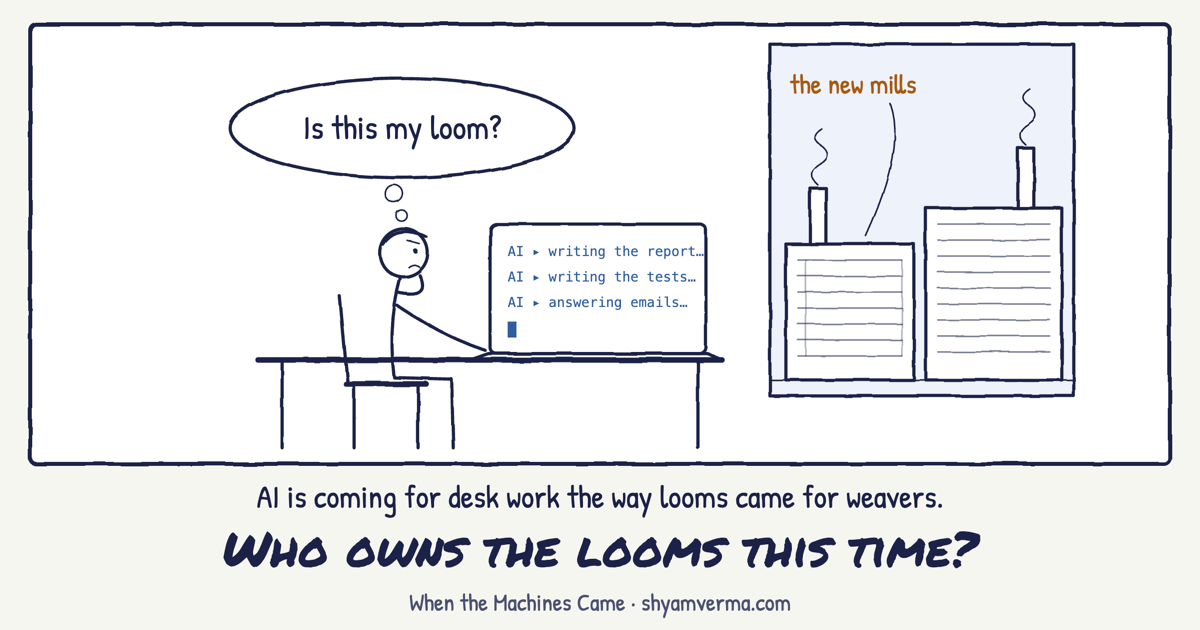
Machines never ended work. They ended one generation’s way of earning a living. What two weavers from 1830 can teach us about living through AI.
In 1830, two weavers sat at their looms on opposite sides of the world. One lived in Bolton, in the north of England. The other lived near Dhaka, in Bengal.
Both were skilled. Both worked long hours. Both were beaten by the same thing: the new cotton machines of England.
The Bolton weaver stayed poor for the rest of his life, and his children went to work in the mills that had ruined him. The Dhaka weaver, whose family had made muslin, a cotton cloth so fine that buyers called it “woven air”, lost his trade completely. There were no mills nearby for his children to join. He went back to the land and became a farmer.
Same machines. Same skill. Same effort. What decided their fate was not talent. It was who owned the machines and who wrote the rules. England did both. India, ruled by Britain, could do neither.
Today a new machine has arrived. This time it sits on your desk.
The pattern that repeats
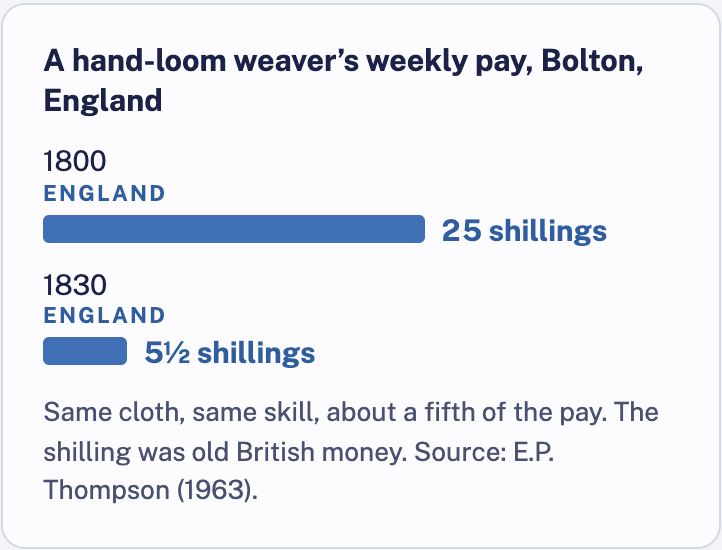
Here is what the machine did to the Bolton weaver’s pay.
Look at almost any trade that met a machine, and you see the same four steps:
- A skill gets cheap. The machine does the work faster and at a lower cost.
- The industry grows. Cheaper goods bring in many more buyers, so the trade as a whole gets bigger.
- Owners gain first. Whoever owns the machine and the customers takes most of the early gains.
- Handmade work shrinks into a luxury. A small, high-price corner survives.
Cloth shows all four. Mill owners such as Richard Arkwright became very rich. In India there was an extra twist. Britain had banned Indian cloth from its own market in 1700 and 1721 to protect English weavers. Once its machines were cheaper, it sold its machine cloth in India. Hand weaving survives in India today, but mostly as poor work, with luxury silk at the top.
The same shape shows up far beyond cloth. The typewriter ended hand copying, then created a new job, the typist. Indian bank unions fought computers in the 1980s; the computers came anyway, and India’s IT industry later grew to more than 5 million jobs. Hand-painted film posters and shop signs were everywhere in India until cheap printed banners replaced most of them within about ten years.
The workers who did best were the ones whose skill could move to the new machine, or who found the part of the work the machine could not do.
Right about ten years, wrong about fifty
People living through the change guessed the next ten years well. They got the next fifty wrong.
- The skilled worker expected ruin. Largely true. Many stayed poor for life.
- Their children expected the same ruin. Wrong. They found factory jobs, and later office jobs.
- The industry was expected to shrink. Wrong. It grew many times over.
- The owner expected riches forever. Half true. Later, competition cut profits.
The hardest part was the wait. Between about 1780 and 1840, the amount each British worker produced rose by nearly half. Real pay, meaning what wages could actually buy, rose by only about a tenth. Historians call this long gap “Engels’ pause”, after a writer who saw the misery of Manchester’s workers at the time.
The new wealth was real. It reached the workers’ grandchildren, not the workers.
Across the world, the shift was even bigger. The economist Paul Bairoch estimated each country’s share of everything the world made. His numbers are rough, but the shape is clear.
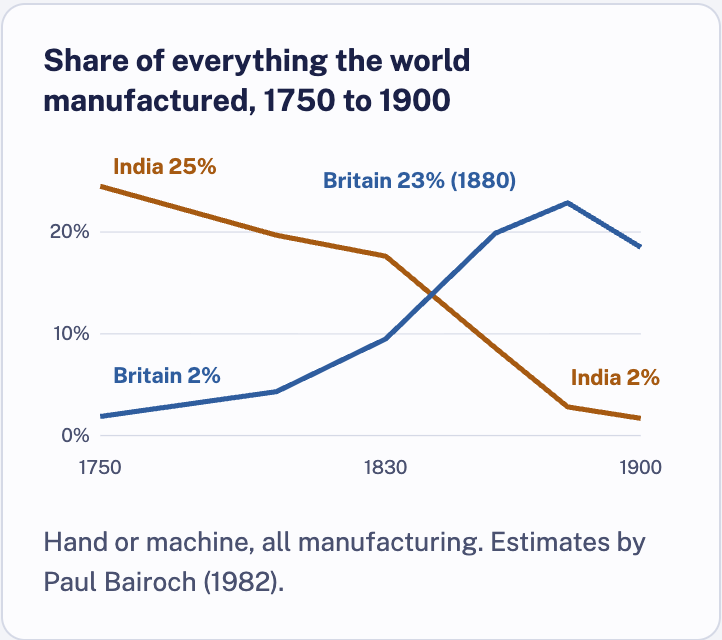
So who won? It is tempting to say the people who moved early. That is only half the answer. Power decided who could own a machine. Timing decided who did. Many winners began as craftsmen who moved early: Arkwright had been a wig-maker, and Josiah Wedgwood, who built a great pottery business, was a potter’s son. But the Dhaka weaver could never have built a mill under British rule, however early he moved.
Being early mattered only for those who were allowed to play.
The spending loop
That long wait did not hurt the weavers alone. A lost wage does not stop at the mill gate.
One person’s spending is another person’s job. When many people lose work at the same time, the damage spreads. Jobs are lost, so families spend less. Shops sell less, so they cut more jobs. And the loop turns again.
In England, the hard years of the 1840s are remembered as the “Hungry Forties”. The Bolton weaver could not buy food, so the baker and the landlord suffered too. England broke the loop with cheaper goods, new industries such as the railways, and by selling its extra cloth abroad.
Much of that cloth was sold in India. When the Dhaka weaver lost his income, his village market lost a buyer.
England partly solved its own job losses by sending them to Bengal.
Over time, the machines did make life cheaper, and that is how new jobs appeared. As food took a smaller share of each family’s money, the rest went to clothes, then homes and cars, then services and screens. New jobs followed the money.
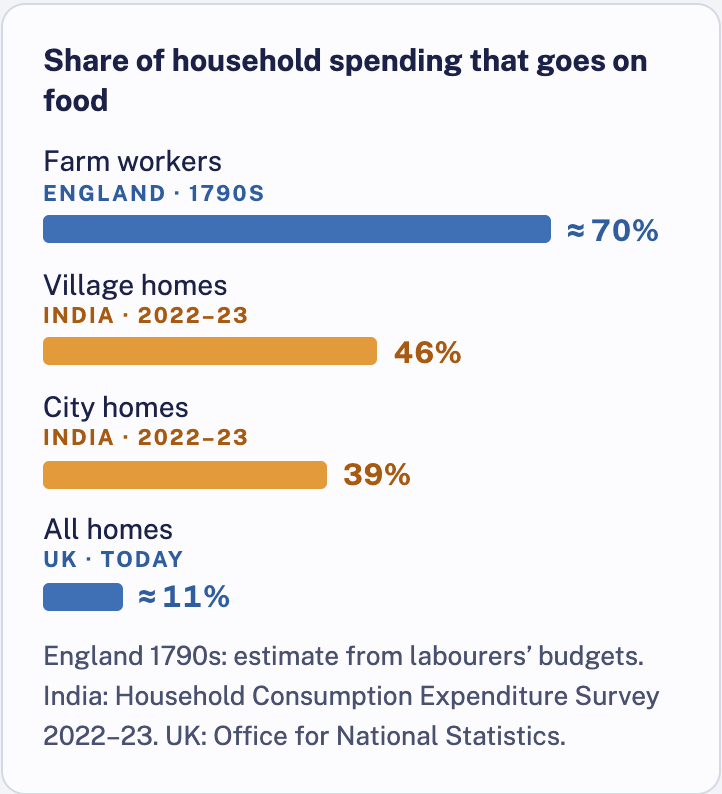
The same loop could matter today. In Bengaluru, Hyderabad or Pune, one tech salary pays a landlord, a driver, a cook, a school, restaurants, delivery riders and the local shopkeeper. If many of those salaries shrink at the same time, the loop could start again. That is a risk to watch, not a forecast.
Who paid
History books measure this change in averages. People paid for it in four ways.
In the body. An 1842 report found that in Manchester, the average age at death was 17 in labourers’ families and 38 in wealthy ones. Many children’s deaths pulled the labourers’ figure down, but adults suffered too. Cotton dust damaged their lungs.
In pride. A respected master became a factory “hand”, working to the clock and the bell. In India, where craft was tied to caste, whole communities lost their standing. For some lower castes, though, leaving the family trade was also an escape.
In the family. Work left the home. Mills hired women and children because they could pay them less. The Bolton weaver’s wife earned the wage, then came home to cook and care. Their ten-year-old worked twelve-hour shifts.
In beliefs. People reached for new meaning. England turned to new churches, to the idea of “self-help”, and to the fight for the vote. India answered with Swadeshi, the movement to buy Indian goods, and later with Gandhi’s spinning wheel as a symbol of freedom.
Where you stood decided what you saw. The weaver felt pride, then fear, then shame. His children had a hard start, but a road forward. His grandchildren inherited schools, factory laws and cheap clothes, and could hardly imagine what had been lost. The government first sided with the owners: in 1812 England made breaking a machine a crime punishable by death. Reform came, but slowly.
Faster this time
All of that took about two generations. The weaver’s grandchildren had time to recover. We will not get that much time.
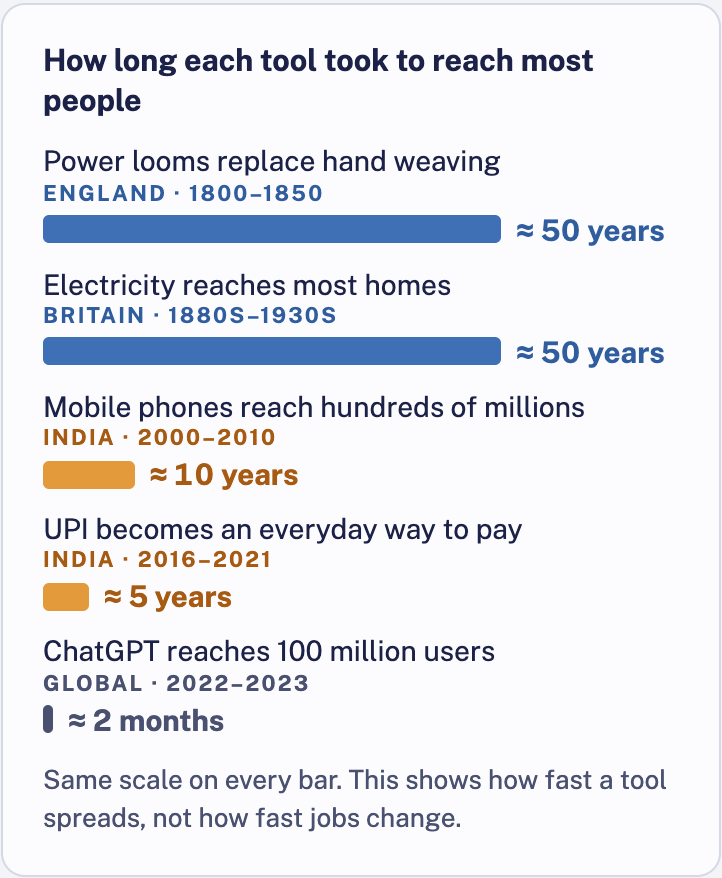
Jobs change more slowly than tools. A company has to learn a tool, trust it and rebuild its work around it. But that slower change now happens within one working life. In 1830, the next generation absorbed the shock. Today, the same person may have to absorb it more than once.
Today’s weavers
Meet Arjun. He is 38 and leads a software testing team in Bengaluru. Twelve years ago, his skill was rare and well paid. His salary pays for a flat, his parents’ medicines and his daughter’s school. This year, an AI tool started writing many of the tests his team used to write by hand. Nobody has lost their job yet. But fewer new people are being hired, and Arjun has started to wonder what he is for.
Arjun is not a real person. He is a composite, built from the kind of work that is changing now.
AI rarely removes a whole job at once. It takes over tasks. The jobs most exposed are the ones made mostly of tasks a machine can now do: drafting text, writing routine code, summarising data, answering standard questions. Writers, translators, junior coders, analysts and support desks are closest to the loom.
And the muslin weavers of Dhaka? The uncomfortable parallel is India’s IT and back-office services, built on skilled work sold at a low price to the rest of the world. That is a question, not a forecast. But it is worth asking.
Three things are different this time. It is faster: the change lands within one career. It is wider: it touches many desk jobs at once, so there are fewer nearby trades to move into. And it is cheap: a weaver could never buy a mill, but anyone can use AI for a few dollars a month.
For the first time in 250 years, the worker can afford the machine. Owning it is another question.
Some things will likely stay the same. Whoever owns the customer, through a brand, a platform or a relationship, will gain most. Mid-career workers like Arjun will be hit harder than the young. And gains will be shared only when someone pushes for it.
The new mills
The ownership question does not stop at Arjun’s desk. It applies to whole countries, just as it did to Bolton and Dhaka.
In 1800, power came from owning the looms, the ships and the trade rules. Today it comes from owning the chips, the data centres, the energy and the AI models. As of October 2026, one American company designs most of the chips that run AI, and most of the world’s most advanced chips are made in Taiwan. The leading closed AI models come mostly from a few US companies, while China leads in free, open models such as DeepSeek and Qwen. Rules have become weapons again: the US limits sales of advanced chips to China, and China answers with its grip on the rare minerals that electronics need.
Britain no longer owns the mills. It has a national plan to build its own computing power, and leans on close ties with the United States.
India, unlike Bengal in 1830, is free to build. It is a huge market, full of engineers, and it built UPI, one of the world’s best public payment systems. It is funding shared AI computing and Indian AI models, and building its first large chip factory in Gujarat. But pressure comes from outside. US tariffs on Indian goods, and a steep new US work-visa fee now tied up in court, have shown how quickly trade rules can hit Indian jobs.
Renting the machine is not owning it.
A country, a company or a person that only uses someone else’s AI pays the owner, and lives by the owner’s rules and prices. For you, this means your job is now shaped by trade fights and visa rules as well as technology. A skill that pays in only one country, or only through one visa, carries extra risk. Skills that travel, clients in more than one place, and tools you can switch between are safer.
On jobs and AI: the IMF estimated in 2024 that about 40% of jobs worldwide are exposed to AI, and about 60% in rich countries. A 2025 Stanford study found that jobs for US software developers aged 22 to 25 had fallen by about a fifth since late 2022.
How to adapt
So what should Arjun do? History offers five moves. Each one worked for someone. None is a guarantee.
- Split your job into tasks, and start using AI on the dull ones now. Twenty minutes a day on your real work teaches more than any course.
Then: blacksmiths who learned engines became mechanics. Those who waited lost the trade. - Move toward what needs you. Judgement, trust, care, taste, local knowledge, and being the person who answers for the result.
Then: when cameras arrived, painters moved to what cameras could not do. - Own something. A small tool, a set of clients, a reputation, a niche. The machine is cheap now. The customer relationship is what pays.
Then: Wedgwood went from potter’s son to owner. - Build a cushion. Save for several months and carry fewer fixed loans. Change takes time, and time costs money.
Then: the Bolton weaver had no savings, so he had no time to adjust. - Don’t adapt alone. Learn with peers. Join a professional group or union. Groups can bargain; individuals mostly can’t.
Then: in India, Amul’s small dairy farmers owned the machines together, and kept their cows.
The catch: what if everyone moves early?
Then early stops being early. An advantage everyone has is no advantage. History shows three traps when a whole crowd makes the same move.
The crowded safe job. In the 1790s, cheap machine-spun yarn made hand weaving pay well, and crowds rushed into it. Within a few years the trade was so crowded that pay began to fall, even before the power loom spread. Much later, India’s engineering-college boom produced more graduates than good IT jobs. So look one step to the side of the crowd, and pair the new tool with something rare: your trade, your region, your language, your clients.
The bubble. Britain’s Railway Mania of the 1840s ruined many investors, but the railways stayed and served the survivors. The dot-com crash of 2000 followed the same path. So be early with your time and curiosity, but careful with your money.
The race to the bottom. If every company cuts staff with AI, rivals cut prices too, profits fall, and fewer salaries mean fewer customers. The spending loop returns. Some races are won together, through co-ops, professional groups, unions and fair rules.
And this cannot rest on workers alone. Employers can retrain before they replace. When Henry Ford roughly doubled wages in 1914, far fewer workers quit, and he kept the skilled people his factory needed. Families can teach children how to learn, not just one trade. Governments can support people through the switch. Last time, England passed its first real factory law about 60 years after the first big mill opened. We cannot afford to wait that long again.
The cost to the mind
Even with good advice and fair rules, one cost remains, and it is the one we talk about least.
Factories broke the body. Offices stilled it. AI tests the mind.
We learned to care for the body when offices made us sit; we had to invent “exercise”. Now the strain moves to the mind: who am I, what am I worth, and what comes next? Two questions help, and most of us never ask them.
Is my work a passion, or my identity? “I love weaving” is a passion. If the loom stops, I am still me. “I am a weaver” is an identity. If the loom stops, who am I?
Is providing how I care, or what I am worth? “I work to look after my family” is a way to care. If income falls, I can find another way to care. “I am only good if I provide” turns income into worth. If income falls, I feel worthless.
The Bolton weaver whose wife now earned the wage felt he had failed, because he had been taught that a man’s worth was his wage. Arjun may feel the same pull when his salary stops growing.
When work becomes your whole identity, two traps open. The first is endless hustle: work becomes the only proof that you matter, so you never stop, and every new AI tool feels like a race you are losing. The second is losing yourself: you forget what you enjoy or want outside work, so when the work changes, there is little left to stand on.
Both traps run on “shoulds”. I should work harder. I should be further ahead. I should not rest. Many people live with a quiet dread and call it duty. Fear about money and work can weigh so heavily that some people reach a point where they don’t want to go on. That is not weakness or failure. It is a sign to get help, and help works.
If this is you, talk to someone today.
India: Tele-MANAS, 14416 (free, 24 hours). UK: Samaritans, 116 123 (free, 24 hours). Elsewhere: your local helpline or a doctor.
Some thoughts are worth catching and turning around:
- “If I lose this job, I am nothing.” My job is something I do. I am more than it.
- “Losing this income will hurt my family.” That fear is real, and worth planning for. Less money is a problem to solve, not a verdict on who I am.
- “Rest is for when the work is done.” The work is never done. Rest is part of the work.
- “I can’t tell anyone I’m struggling.” Talking early is a strength. Most people around you feel some of this too.
What 250 years teach
The machines of the 1800s made the world far richer. They also left a generation of skilled workers poorer for life, and drained one region’s industry to feed another’s. Both things are true. Which one you lived depended on what you owned, where you lived, and whether anyone stood with you.
This time the machine is cheap enough for almost anyone to use. That is new, and it is hopeful. But using a machine is not owning it, and moving early helps only until everyone does.
You are not your job.
Start now, in small steps. Waiting never brought the old pay back.
Early is relative. Keep moving, and avoid the crowd.
Own something: a skill, a tool, a customer, a name.
Keep the part of your work that needs a human.
Don’t adapt alone.
One weaver’s children joined the mills. The other’s went back to the fields. The difference was who owned the looms. Who owns them this time?
Sources
- E.P. Thompson, The Making of the English Working Class (1963)
- Robert C. Allen, “Engels’ pause” (2009)
- Sven Beckert, Empire of Cotton (2014)
- Prasannan Parthasarathi, Why Europe Grew Rich and Asia Did Not (2011)
- Paul Bairoch, “International Industrialization Levels from 1750 to 1980” (1982)
- Brian Merchant, Blood in the Machine (2023)
- Carl Benedikt Frey, The Technology Trap (2019)
- Daron Acemoglu and Simon Johnson, Power and Progress (2023)
- Edwin Chadwick, Report on the Sanitary Condition of the Labouring Population (1842)
- Dadabhai Naoroji, Poverty and Un-British Rule in India (1901)
- India Household Consumption Expenditure Survey 2022–23 (Ministry of Statistics)
- IMF, “Gen-AI: Artificial Intelligence and the Future of Work” (January 2024)
- Brynjolfsson, Chandar and Chen, “Canaries in the Coal Mine?” Stanford Digital Economy Lab (2025)
- UK Government, AI Opportunities Action Plan (January 2025)
- Government of India, IndiaAI Mission (Cabinet approval, March 2024)
- India–UK trade deal in force from 15 July 2026: HLC summary
- US–India interim trade framework (February 2026): Fox Business
- H-1B fee status (September 2026): Business Today
Numbers are rounded and some are estimates. Arjun is a composite, not a real person.